

Trump on AI guardrails took center stage Sunday as the president dismissed warnings that artificial intelligence could spiral out of control, even as he said he supports safety measures.
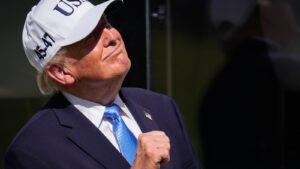
Speaking with reporters at his Doonbeg golf resort in Ireland, President Trump argued that dire predictions about AI were overstated and attributed the rhetoric to unspecified “negative forces.” He said the United States leads China in the field and should maintain that edge. “Whoever wins AI, wins,” Trump said, adding that guardrails can be implemented without slowing progress.
Trump did not elaborate on what he meant by “negative forces.”
Trump on AI guardrails and competition with China
Echoing the president, House Speaker Mike Johnson said on CNN’s State of the Union that he opposes any moratorium on AI development, warning that “China will overlap us.” He urged tech companies to take the lead on building safer systems and cautioned that rushing into emergency legislation could cost the U.S. its technological advantage. “We got to have steady hands at the wheel,” Johnson said.
Johnson’s comments came amid a broader debate over Trump’s foreign and security posture, including issues such as strikes on Russian diesel plants and military aid.
Tech leaders urge pacing AI’s frontier
The comments followed a public call from Anthropic CEO Dario Amodei to slow the rate at which AI capabilities are advancing. In an essay posted Saturday, Amodei warned that humans could lose control of powerful systems and that AI poses risks for cyberattacks and bioterrorism. He advocated international coordination, third-party evaluators embedded in labs to track safety practices, and said Anthropic would adopt those measures unilaterally.
Elon Musk and OpenAI CEO Sam Altman backed Amodei’s concerns in weekend social media posts. Altman also told Fortune that he would delay any move to take OpenAI public until at least 2027 due to safety issues, and that the company has discussed pausing certain tests to improve safeguards.
White House science adviser weighs in
David Sacks, co-chair of the President’s Council of Advisors on Science and Technology, responded on X by effectively inviting companies to proceed with their own slowdowns if they deem it necessary. “If the unreleased models are scary enough that you think you should slow down, I support your decision to be responsible,” he wrote, while urging tech leaders not to claim they need external permission and noting potential product-liability exposure if their tools enable a damaging cyberattack.
For Hawaii’s tech and defense sectors, the debate underscores the tension between safeguarding innovation and staying competitive with global rivals, especially in areas tied to Indo-Pacific security and local research partnerships.














One Response