
VERACRUZ, Mexico — Veracruz La Bamba echoes from the city’s central clock tower every hour, a reminder that the historic port claims the centuries-old original, not the 1958 rock hit by Ritchie Valens. Locals describe it as nothing less than their hymn.
The song is the best-known standard of son jarocho, the regional sound of Veracruz. The music lives at community celebrations called fandangos, gatherings born from the Gulf Coast’s blend of European, Caribbean, and Indigenous cultures that took root after Hernán Cortés established Mexico’s first port here in the early 1500s.
This syncopated folk music, with its call-and-response verses and percussive dancing, has been part of local life for more than 300 years. While fandangos are spreading far beyond Mexico, the truest expression still thrives in Veracruz.
Veracruz La Bamba and the fandango tradition
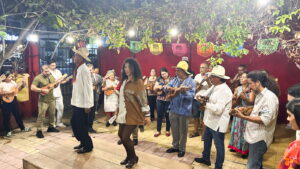
On a sweltering Saturday night in mid-August, a couple takes to a wooden platform as a woman’s floral skirt flares with each heel strike and her partner’s straw jarocho hat glistens with sweat. Nearby, a musician in a black T-shirt scrapes and thumps a quijada, or donkey jawbone, for a rattling rhythm.
Ice-cold beer flows, tamales wrapped in banana leaves are passed around, and a trio grows into a circle of players wielding the jarana, a small eight-string guitar carved from a single block of Spanish cedar.
Before long, La Bamba draws in two dozen jaraneros. The three-chord vamp stretches into a trance, lasting around 15 minutes as dancers rotate across the platform.
“Para bailar La Bamba, Para bailar La Bamba se necesita una poca de gracia, Un poca de gracia y otra cosita y arriba y arriba…”
“Fifteen minutes is nothing,” said Tacho Utrera, a Grammy-winning jarocho musician and renowned luthier. He recalled massive fandangos in Tlacotalpan, where as many as 80 musicians join and La Bamba with dancing can continue for an hour as players and dancers keep changing.
In the 1960s and 70s, the tradition waned. Fandangos and son jarocho were seen as low-brow, and gatherings shrank to small family events.
Gilberto Gutierrez, a leading figure in the genre and a founder of the band Mono Blanco, said the music was dismissed as something for “drunken people,” prompting some musicians to set their instruments aside or leave for Mexico City in search of work.
Today, with audiences in Mexico and abroad seeking authenticity and soul, son jarocho is resurgent. In Veracruz, weekend fandangos mark baptisms, birthdays, wakes, saints’ days, and simple joy.
A monthly Saturday fandango in the old city is hosted by the caSon Cultural Center, which celebrates its 25th anniversary this year. Gutierrez founded the center and said these nights happen because musicians, dancers, singers, and cooks create a community.
Humanity needs to come together and belong, he added, which helps explain the music’s spread. Son jarocho now resonates in Mexico City and across Argentina, Spain, Finland, Germany, Switzerland, Denmark, France, Tokyo, Canada, and U.S. cities with large Latino communities such as Los Angeles and New York.
An essential element is el zapateo, a form of tap that doubles as percussion to drive the strings. The wooden stage is the tarima.
“To step onto a tarima is an act of respect and skill — that you know how to dance,” said Ada Veronica, a high school teacher from Puebla who has danced for two decades. “You shouldn’t get up there if you don’t know what you’re doing.”
Classes in jarocho music and dance at El caSon fill quickly. Even as many young Mexicans embrace reggaeton and corridos tumbados, they are flocking to fandangos and other ways to enjoy music.
“You simply feel it, you live it,” said 28-year-old teacher Paloma Rizo, who picked up the jarana this year and joined the jam with enthusiasm. Even those unfamiliar with the tradition, she said, are drawn in by the dancing and playing.
Locals often describe the fandango spirit with the word convivencia. Literally “to coexist,” in this setting it is better understood as being alive together, a feeling echoed in folk traditions far from Veracruz, from community music hubs in Europe to grassroots cultural centers around the world.