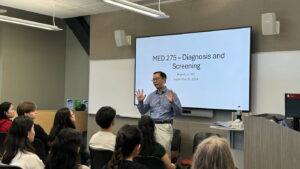

Lung cancer treatment is changing fast, bringing new hope to patients as targeted drugs, better testing, and emerging screening tools reshape care. That rapid progress is personal for Dr. Bryant Lin, a Stanford medical professor and co-founder of the school’s Center for Asian Health Research and Education, who was diagnosed with Stage IV lung cancer two years ago despite never smoking.
“Super ironic that I would be co-leading the center that supports research and education in this disease, and I get diagnosed myself,” Lin says. He tells students he is lucky, and optimistic about personalized therapies. “If we are not able to cure lung cancer, we can at least turn it into a chronic disease.”
Survival rates are starting to reflect the shift. Across all stages, the five-year survival rate has doubled over three decades to about 30 percent, according to national data. Early detection still matters most. For localized disease, five-year survival reached 67 percent between 2015 and 2021.
Personalized lung cancer treatment advances
Targeted treatment
Lung cancers are genetically diverse, which historically made treatment difficult. A key advance is comprehensive genomic testing that can pinpoint a mutation driving abnormal cell growth, according to UCLA oncologist and researcher Dr. Jonathan Goldman. “We can pick a drug that’s really been developed for that type of cancer,” he says.
These medicines can shrink or stabilize tumors with fewer side effects than traditional chemotherapy because they focus on the altered cells. “Survival used to be under a year, and now it’s often several years and sometimes many years,” Goldman says.
Comprehensive genomic testing is already available, and a recent New England Journal of Medicine study led by Goldman found sharp reductions in recurrence when patients with certain rare subtypes received targeted treatment first. Yet access remains uneven. Fewer than half of U.S. lung cancer patients receive genomic testing before treatment, he says, since it is not universally considered standard of care and many clinicians are still catching up with fast-moving research. “The next step is not just these scientific discoveries, but learning how to implement these findings.”
Lin began with a daily targeted pill, Tagrisso, after his May 2024 diagnosis. Months earlier, federal regulators had cleared its use with chemotherapy based on data showing longer survival. “I am a beneficiary of years, of decades, of research,” he says. “It is amazing how rapid our advances have been.”
Affordability
Cost remains a hurdle. Even with his credentials, Lin has faced insurance pushback on high-priced drugs, including prior authorization requirements and denials when therapies were not yet part of formal protocols. One medicine carried a list price of about $16,000, delaying care at a critical time, he says. “Oral drugs and the IV drugs, they are hundreds of thousands of dollars. I do not know too many people who could afford to pay out of pocket.”
About a year into treatment, Lin’s initial therapy stopped working. By then, another option had been approved, combining amivantamab, an antibody that engages the immune system, with lazertinib, a pill targeting EGFR mutations. Lin says newer therapies have extended not only his life but also his quality of life. “My symptoms are really well controlled. I can live my life. I can speak. I do not think I have coughed once in our conversation.”
Personalized treatment
Progress in related cancers may soon benefit lung cancer as well. One promising crossover is with pancreatic cancer, where the same KRAS gene family that drives a sizable share of lung cancers is a key culprit. In August, the FDA approved Rasonque, or daraxonrasib, which doubled survival to more than 13 months in late-stage pancreatic cancer trials, a rare gain against that hard-to-treat disease.
Researchers and companies are also testing personalized mRNA vaccines designed to match an individual tumor’s genetic profile, with early signs that they can re-engage the immune system. “I have been investigating that for myself, personalized mRNA vaccine,” Lin says.
While treatments advance, Lin continues to press for better screening. Only about 18 percent of people at high risk receive annual low-dose CT scans, the recommended standard. New approaches may help. AI imaging tools and increasingly sensitive blood tests could detect or even predict disease years earlier, potentially offering options beyond CT scans and boosting early detection.
For now, Lin says he is focused on staying a step ahead. A recent scan showed disease progression, and he is weighing a newly approved antibody drug or a clinical trial. He also makes time for family, from San Francisco Giants games with his wife and teenage sons to tinkering with a vintage seafoam-green Smith Corona typewriter as he works on his forthcoming book, Sunshine: An exploration of living when you are dying. “We stayed up late when we got the typewriter, just banging away, making the noises and writing crazy things on the paper.”
Life, he says, still calls for a little silliness, even as he balances hope with realism. “I am hopeful. But, absolutely, the odds are against me.”