
Makaliʻi Metrics soil lab is getting plenty of hands dirty in service of Hawaiʻi’s ʻāina. Founder and CEO Daniel Richardson spends his days gathering samples for the company’s new testing facility in Mōʻiliʻili, aiming to reveal what is in local soils and to guide restoration using both traditional practices and modern land-management tools.
The lab goes beyond standard nutrient reports familiar to farmers, gardeners and researchers. Along with conventional analyses, Makaliʻi Metrics compiles insights tied to geology, volcanic soil profiles, microclimates and historical land use, drawing from archival newspapers, kūpuna and traditional narratives. Clients also receive practical direction for the post-plantation landscape and help addressing invasive species. Richardson says his work is driven by a commitment to stewardship and regeneration of the ʻāina.
“I see myself as a tool that’s being used in this moment,” he says, hoping the company’s lessons serve future farmers and land caretakers.
A key kākoʻo is former kalo farmer Zachary Pilien of Purple Maiʻa Foundation, who serves as chief technology officer. He and Purple Maiʻa technologists manage the lab’s data systems and machine learning models, and, as he puts it, help “dig holes.”
Makaliʻi Metrics soil lab fills a need
Makaliʻi Metrics was founded in 2022 and opened its Mōʻiliʻili lab on May 14 after a University of Hawaiʻi at Mānoa soil testing lab paused operations, in part due to federal funding cuts. Richardson previously worked at the UH lab while earning undergraduate and graduate degrees in natural resources and environmental management.
The company initially aimed to relieve UH’s workload. When the university lab closed, backlogged samples mounted, and Richardson stored hundreds of them in freezers at the new site.
“We’re just like, shoot we’ll just do it ourselves,” he says.
The venture grew from a team that includes co-founder Kūhaʻo Zane, creative director at Sig Zane Designs and president of the Edith Kanakaʻole Foundation, along with Kamuela Enos of UH’s Office of Indigenous Knowledge and Innovation and UH soils professors who mentored Richardson. The Purple Maiʻa and Edith Kanakaʻole foundations provided funding and support.
Richardson says clients needed more than spreadsheets. With help from Purple Maiʻa, the company built a user-friendly dashboard that presents results and links to historical Hawaiʻi newspapers and archived place-based information.
Zane shares the vision of integrating Kanaka perspective with soil analysis, noting the possibility of distinct soil signatures associated with kino lau, plants connected to Hawaiian akua and ancestors. He also leads branding for Makaliʻi Metrics.
Hawaiʻi as a Leader in Soil Science
Richardson believes Hawaiʻi’s diversity of microclimates and land ages makes it a natural laboratory and a potential leader in soil science. He says the U.S. Department of Agriculture’s Natural Resources Conservation Service recently toured the facility to assess its potential role in Pacific region soil analysis.
He adds that the lab’s recommendations consider the economics and risks of farming, from the cost of compost to the uncertainties that affect yields and family livelihoods.
Education is central to the mission, and Makaliʻi Metrics welcomes high school and university interns passionate about ʻāina stewardship. Interested students can email makaliimetrics@gmail.com. The company partners with the Kōkua Foundation and Purple Maiʻa to host interns.
Looking ahead five years, Richardson hopes to firmly weave ancestral practices with modern analytical tools and to educate widely. He also envisions a robust local team of ʻāina practitioners, scientists, students, interns and graduates working in Hawaiʻi on food security and soil degradation.
In the lab’s freezers, bags of soil from Oʻahu, Kauaʻi and Hawaiʻi island are stacked and labeled by name and GPS coordinates. Standard tests cost $75, with specialty panels for macadamia, coffee and fruit at $95. Larger projects with multiple samples are priced accordingly, and water testing is available. Restoration packages include baseline carbon tests, nutrient mapping and zone analysis for large restoration or transition efforts.
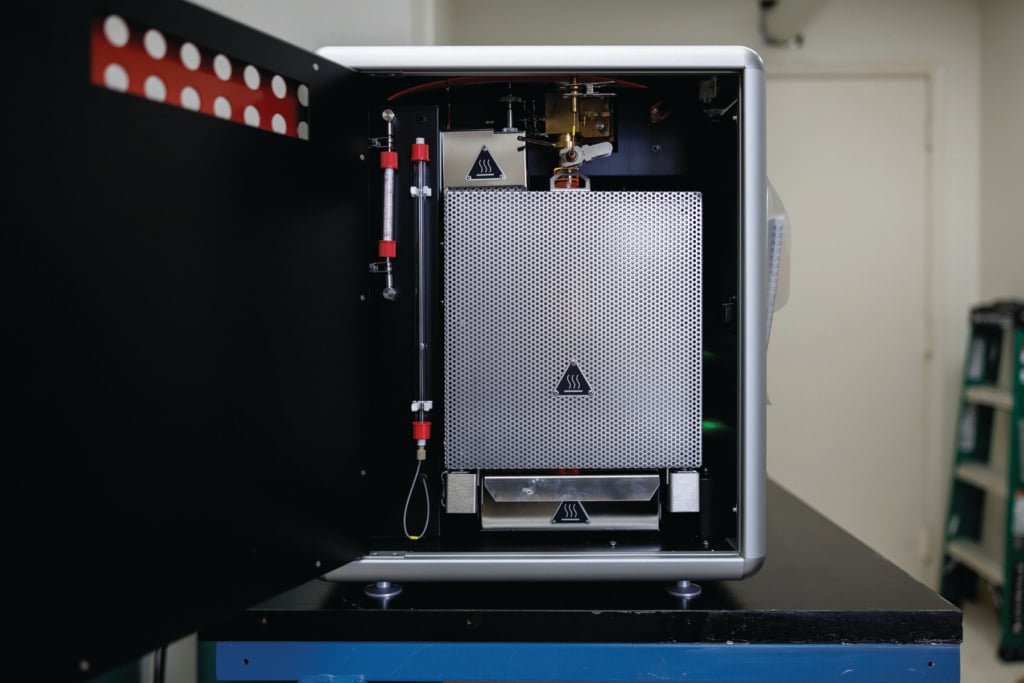
Core measurements include nitrogen, carbon, hydrogen and sulfur. A large spectrometer expands the profile to elements such as potassium, magnesium, calcium, phosphorus, sulfur, boron, manganese and aluminum. Clients can click through sample sites on the dashboard to learn why each nutrient matters to plant health.
Building Relationships Adds to Understanding
Richardson says the lab prioritizes relationships with land stewards. He does not want a black-box experience, and finds that on-the-ground visits often surface the most useful insights.
He points to two kalo varieties planted a few steps apart, where one thrives while the other lags. Field visits prompt targeted sampling and context that numbers alone might miss.
One effort that excites Richardson is huiMAU in East Hāmākua on Hawaiʻi island, which focuses on ʻāina revitalization using ancestral knowledge and practices to grow healthy food and ecosystems for generations. The nonprofit stewards more than 1,000 acres leased from Hawaiʻi County and Kamehameha Schools, where eucalyptus was planted 35 years ago and never harvested. It has restored 35 acres and plans another 10 to build what Executive Director Noʻeau Peralto calls the largest regenerative ʻulu agroforestry system in Hawaiʻi, with banana, kalo and other ancestral crops. Makaliʻi Metrics provided soil testing for the project.
Founded in 2011 by Peralto and Haley Kailiehu, huiMAU also researched traditional practices from the area. One method, pākukui, involves burying kukui material in pits and growing kalo above the composted layer. The practice is referenced in Hāmākua through oli and historic newspapers. Trials tracked how the technique influenced soil nutrients, and Richardson says newer technologies can complement other sustainable pre-plantation methods.
He praises huiMAU for coupling knowledge with the ability to marshal resources and make substantial progress. Peralto says huiMAU now employs 21 full-time staff, making it the community’s second-largest employer, with programs spanning ʻāina restoration, culture-based education and a food hub.
Peralto says the organization sees itself as part of a long genealogy, carrying forward ancestral connections while adapting practices to today’s realities so future generations have stronger foundations.