
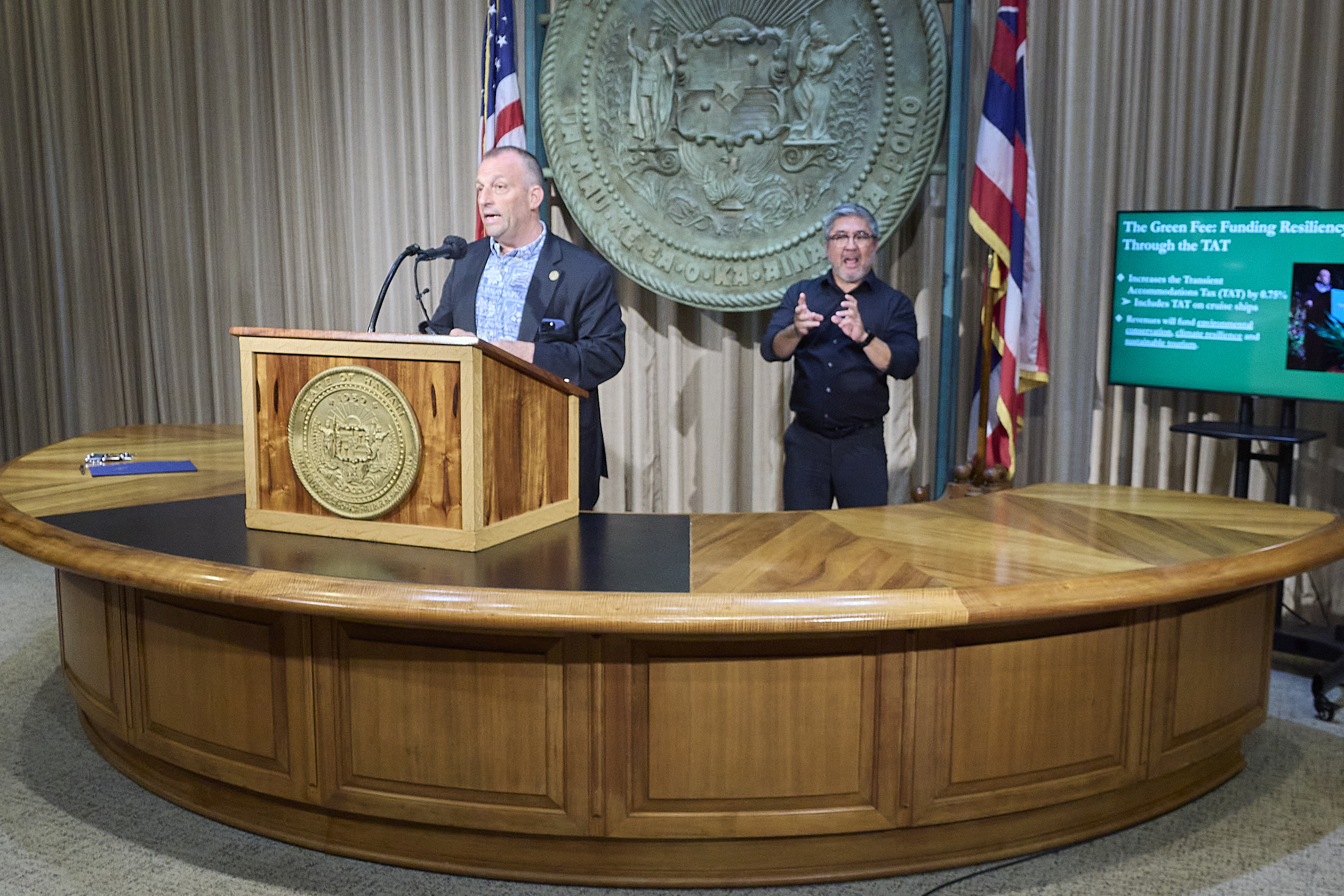
Gov. Josh Green on Friday signed the state’s $20.3 billion budget for the coming fiscal year, but he also indicated a Hawaii rainy day fund veto of a separate $50 million transfer into the Emergency and Budget Reserve Fund.
In a written statement, Green said he may also reject several other measures passed this session, including a plan to form a temporary Public School Realignment and Closure Commission to recommend consolidations of underused campuses.
The budget sets aside $4.53 billion for construction statewide, and Green said it maintains support for affordable housing, local families, public health and economic development at a time of uncertain federal funding. It also funds dozens of conservation and related projects using $129 million generated by the new green fee, largely from a higher hotel room tax, with money designated for 91 projects.
Even with the new appropriations, not all dollars authorized by lawmakers are typically spent. The governor can withhold or lapse funds, and has exercised that authority in recent years. The administration allowed $863 million to lapse in the fiscal year ending June 30, 2024, and another $533 million the following year, which helped bolster future-year balances amid federal cuts and uncertainty.
Green has already signed more than 160 bills into law this year, including changes to previously approved state income tax cuts and a measure allowing automatic rate increases for interisland shipper Young Brothers.
However, he said he intends to veto Senate Bill 2600, which would move $50 million from the general fund into the rainy day fund. He argued that, given recovery needs from disasters and other priorities such as affordable housing and easing the cost of living, it would be unwise to make that transfer now. The administration projects the reserve will top $1.6 billion by June 30, which would be a record balance.
Possible Hawaii rainy day fund veto and education bills
Green also flagged potential vetoes in education policy. One target is Senate Bill 3262, which would require Senate confirmation of the executive director of the Hawaiʻi Teacher Standards Board, the body that oversees educator licensing and certification requirements.
Currently, the standards board selects its director, subject to approval by the state Board of Education, without Senate confirmation. The board opposed the proposal, noting that no other major education leaders require Senate confirmation. In written testimony, staff said the norm is for executive directors to be appointed by their governing boards rather than outside political bodies.
Critics, including teachers and education faculty, have argued the board’s licensing rules can be too restrictive for would-be educators, particularly in special education, Hawaiian immersion and services for English learners. Increasingly, schools have turned to unlicensed teachers to fill vacancies.
Tensions grew earlier this month when the standards board voted not to renew Executive Director Felicia Villalobos for another four-year term. Lawmakers had urged the board to delay action, pointing to possible changes if SB 3262 became law. Green listed the bill among possible vetoes, saying a deeper review is needed to clarify the roles, authority and oversight of the Board of Education and the standards board so that any changes do not create ambiguity.
Green also questioned House Bill 2344, which would set up an independent commission to study school closures and consolidations, with any approved closures to be implemented by fall 2029. Currently, closures are handled by the Department of Education and the Board of Education. Superintendent Keith Hayashi raised concerns, noting the department has an existing process that weighs resources and student access to learning opportunities.
Green echoed those concerns, saying the proposal could duplicate responsibilities and add administrative burdens without clear benefits. Hawaiʻi has not closed a public school since 2011 despite declining enrollment. Last fall, the department said it would examine redistricting rather than closures. DOE enrollment last fall was 150,280 students, down from nearly 170,000 a decade ago, and the state is projected to see the nation’s largest decline in high school graduates by 2041.
The deadline for the governor to issue vetoes is July 15. After that date, any bills not vetoed become law without his signature.