
The Kihei desalination plant is under consideration as Maui County confronts shrinking water margins on the island’s sunny leeward side. During the dry season, production nearly matches demand, a situation county staff described as “dangerously close to capacity.” With more growth planned in South Maui, officials estimate water demand could rise by 6 million to 10 million gallons per day by 2040.
Planning staff with the Maui Department of Water Supply presented the concept to residents at the Kīhei Community Center last week, inviting feedback on a $53 million facility in Kīhei. Attendees did not dismiss the proposal outright, but many questioned the price tag and how the project would handle brine, the salty byproduct of desalination.
Several speakers urged the county to first pursue conservation, recycled water, and infrastructure upgrades, turning to desalination only if those measures fall short.

The county’s presentation showed 2025 capacity running close to monthly peak production. (Courtesy: Maui County/2026)
County officials referenced a 2024 desalination feasibility study by engineering firm Brown and Caldwell and said they are considering a funding application to the U.S. Bureau of Reclamation for planning and design. They emphasized the process is preliminary and planning would not guarantee construction.
The Central-South Maui system is capped at 26.81 million gallons per day, and during dry months it delivers about 26.79 million gallons per day. Much of Maui’s urban expansion is occurring in drier watersheds where groundwater is limited, so water has historically been moved from wetter regions.
That approach is becoming less reliable as rainfall varies, aquifers face pressure, and policies reduce access to Upcountry supplies, prompting officials to view desalination as a contingency source. The recommended Kīhei facility would use reverse osmosis powered by solar energy and draw brackish groundwater from the Kamaole aquifer.
Treating brackish water generally requires less energy and capital than seawater desalination and produces less brine, though overall output is constrained by groundwater availability. Consultants proposed starting at 0.5 million gallons per day and expanding to 2 million gallons per day.
Brown and Caldwell also identified three other Maui locations, with estimated costs between $37 million and $80 million: a second brackish plant in Wailea, a seawater plant in Lahaina, and a brackish or seawater plant in Kapalua. In West Maui, desalination has been tied to future affordable housing, including the 500-home Pulelehua project, which stalled last year for lack of water.
Oahu is moving ahead with the Kalaeloa Seawater Desalination Facility to initially supply 1.7 million gallons per day to ʻEwa. Made in Hawaiʻi Festival organizers have also highlighted the importance of sustainable water and energy use as the state continues to grow.
Conservation or Kihei desalination plant?
Asked whether desalination would take precedence over watershed restoration, officials said it would not. They underscored that protecting native forests and repairing degraded lands remains the first priority because healthy watersheds drive groundwater recharge.
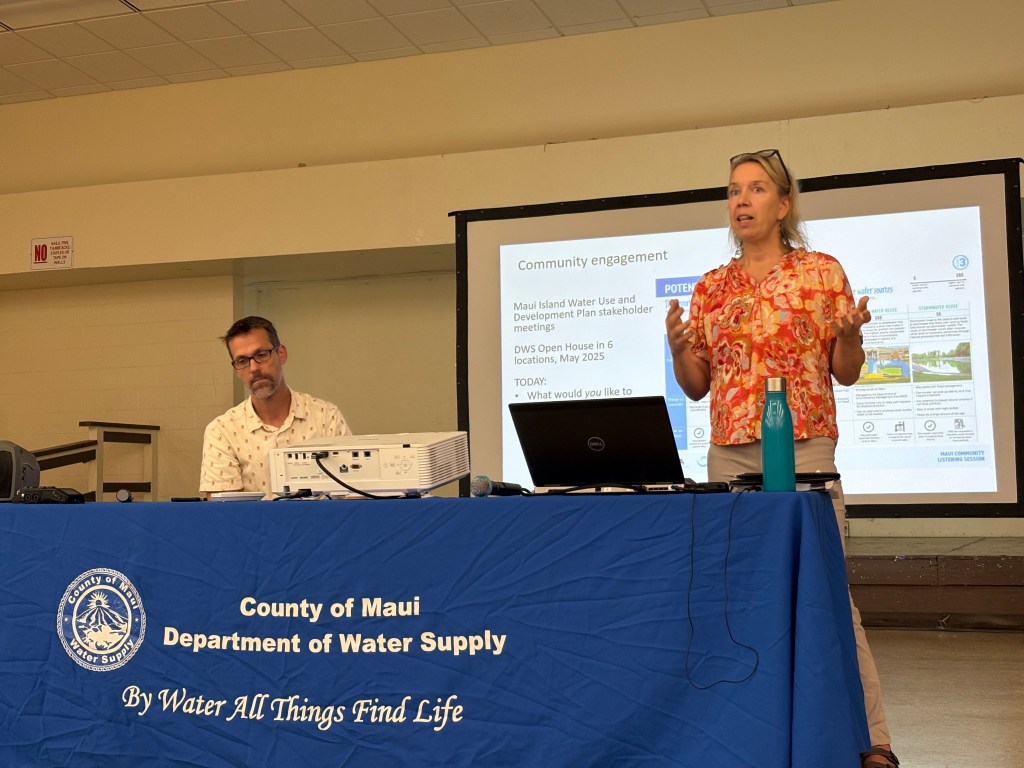
Water officials shared updated demand and cost projections for South Maui. (Twilight Greenaway/Civil Beat/2026)
Residents also pointed to South Maui’s advanced recycled water. The Kīhei plant can produce up to 8 million gallons per day of R‑1 water, but a pipeline extension to Wailea has not been built.
Officials said roughly 3 million gallons of wastewater could be generated and reused locally to offset irrigation demand, though storage tanks and distribution piping remain gaps that are being addressed. System efficiency was another theme.
Staff noted the challenge of maintaining about 2,000 miles of aging mains, including areas with few services per mile. A county water conservation ordinance signed in March was cited as a key step to reduce consumption.
Officials also referenced examples such as mainland cities holding water use flat despite population growth and Bermuda’s cistern and rain-catching roof requirements for new homes. They suggested a future landscape ordinance could limit thirsty turf, though they acknowledged current lawn culture shows there is a long way to go.
What to do with the brine?
The feasibility study flags brine disposal as a major hurdle. Because the waste stream would contain concentrated salts and treatment chemicals, consultants did not find viable beneficial uses.
They recommended deep injection wells to dispose of the brine. That recommendation drew concern.
Maui has faced litigation over wastewater injection wells without proper federal permits, and residents questioned whether deep injection is an acceptable solution. State rules require drinking water to be drawn above the underground injection control line, while brine must be injected below that line and not too near the coast.
Consultants said brine would be injected below the saltwater lens at depths intended to provide at least a 50-year travel time to the ocean, a timeline that some residents viewed as too short. County staff said last week’s session was meant to discuss long-term reliability and options.
They added that community skepticism would not necessarily halt next steps such as seeking federal planning funds. Pursuing funding would refine feasibility, benefits, and impacts, and would not constitute a construction decision.
As one official put it, the county is still at the stage of loading up the car for a potential road trip to desalination. U.S. Bureau of Reclamation programs could play a key role in any eventual project funding.

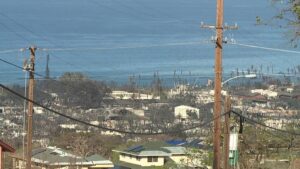
South Maui continues to grow as water supply tightens. (Nathan Eagle/Civil Beat/2024)
County staff said last week’s session was meant to discuss long-term reliability and options. They added that community skepticism would not necessarily halt next steps such as seeking federal planning funds.
Pursuing funding would refine feasibility, benefits, and impacts, and would not constitute a construction decision. As one official put it, the county is still at the stage of loading up the car for a potential road trip to desalination.
Maui County plans a second community feedback session on Thursday, Aug. 13, from 5:30 to 7:30 p.m. at the Lahaina Civic Center Social Hall. More information on county water policies is available from the Maui Department of Water Supply.