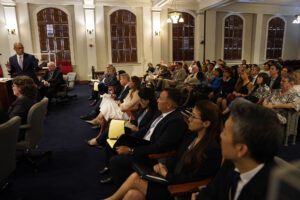

Hawaii Supreme Court justices on Tuesday heard arguments that could determine the future of the East Honolulu City Council race, after more than 8,000 ballots cast for Council Chair Tommy Waters in the primary were not counted due to his ineligibility ruling.
Waters was ruled ineligible to seek another term after voting had already started, leaving the contest in limbo. During oral arguments in Honolulu, the court wrestled with whether Waters can run for a third consecutive term and how to address voters whose ballots were effectively voided.
Attorney Tommy Otake, representing Waters’ supporters, called the situation a “mess” and questioned how disenfranchising voters could be acceptable. In the August primary for the district spanning Waikīkī to Hawaiʻi Kai, Waters finished second to longtime rival Trevor Ozawa.
Following a state judge’s ruling that Waters had reached the City Charter’s two consecutive term limit, Honolulu’s acting city clerk declined to advance him to the general election. First-time candidate Tara Malia Gregory, who placed third, moved on instead.
Earlier this month, Waters asked the high court to put him back on the ballot. A decision is expected by Friday, a ruling that will shape one of the most closely watched political fights of the year and mark the third time the court has been drawn into a Waters-Ozawa showdown for this seat.
Neither candidate would delve into the roots of their rivalry. “This was never personal,” Ozawa said after the hearing, framing the dispute as a matter of upholding the charter. Waters declined comment.
The justices outlined several possible outcomes: a general election rematch between Ozawa and Waters, allowing the primary lineup to stand with Ozawa facing Gregory, or ordering a new primary. Substitute Justice Peter Cahill noted a redo could strain the city clerk’s operations.
City attorney Duane Pang, representing Acting City Clerk Chadd Kadota, said officials moved forward based on the circuit court ruling that sidelined Waters. “We really couldn’t wait, sorry, for this,” Pang told the justices, referring to the pending appeal.
Gregory addressed the court to defend her spot on the ballot, arguing that voter support cannot override legal eligibility. “Votes cannot create legal eligibility where the charter does not provide it,” she said.
Hawaii Supreme Court hears term limit dispute
The case turns on how the Honolulu City Charter defines a term. Elections specialists have noted the charter’s language is ambiguous and open to interpretation.
Waters joined the Council after defeating incumbent Ozawa in an April 2019 special election. He argues that initial service should not count toward the two consecutive four-year term cap because he took office more than four months after the term began.
Last month, Circuit Court Judge James Ashford rejected that view, concluding the council has only two types of terms, regular and vacancy, and that Waters’ first stint was a regular term because no vacancy had been created in the way the charter contemplates. “No one died, resigned or forfeited office in this particular case,” Ashford said at the time.
Ozawa’s attorney, Deirdre Marie-Iha, defended Ashford’s ruling before the justices, saying a four-year term starts on Jan. 2 regardless of when a member is sworn in. “Terms do not move,” she said. “What they’re talking about is Mr. Waters’ tenure in office, how long he served, not how long the term is.”
Justices probe attorneys in Hawaii Supreme Court case
Waters’ attorney Joseph Stewart countered that the charter does not specify how a vacancy must arise, allowing Waters’ first period of service to be treated as a vacancy term and leaving him eligible now.
Associate Justice Lisa Ginoza questioned that logic. Waters’ team cited three prior examples of members serving partial terms after a seat was vacated or a member died, then winning additional full terms.
Ginoza noted those cases involved seats vacated by a sitting member and successors chosen from broad candidate fields. By contrast, the 2019 special election effectively replayed the 2018 contest between the same two candidates. “It wasn’t a full replay of an entire open seat,” she said.
Associate Justice Sabrina McKenna was more receptive to Waters’ position, pointing to ambiguity in the charter’s vacancy language. When eligibility is unclear, she suggested, deference may be owed to voter choice.
“If there is an ambiguity as to a candidate’s eligibility, then that eligibility is to be construed in favor of allowing the person to run,” McKenna said.
Substitute Justice Peter Kubota pressed Waters’ side on the implications. If Ozawa had won in April 2019, Kubota said, Waters’ interpretation could allow service from 2015 through 2031, or 16 consecutive years, despite the charter’s eight-year intent.
“That is the result you wish us to reach?” he asked Otake. “Well, yes,” Otake replied, adding that any broader policy concerns should be addressed by voters through clearer charter language. He proposed that candidates elected before Jan. 2 serve four-year terms, and those elected after Jan. 2 serve vacancy terms, to avoid the court having to infer legislative intent.
The case has also required an unusual assembly of a conflict-free panel because both Waters and Ozawa are attorneys. Eight judges recused, including new Chief Justice Vladimir Devens, who previously served on the board of a carpenters union political group that has supported Waters through independent spending this year.
Associate Justice Todd Eddins and five of seven Intermediate Court of Appeals judges also recused without stating reasons, which judiciary officials said is not required. Circuit judges Cahill, Michael Soong and Kubota were assigned as substitutes.
Separately, 40 district voters who support Waters filed their own case urging that he appear on the November ballot. One of them, Becky Gardner, said after the hearing that an earlier ineligibility ruling might have drawn more candidates into the race.
She criticized the timing of Ozawa’s eligibility challenge, which came after the filing deadline, as giving him a clear advantage. “The timing element, I think, just reflects bad faith,” she said.
For additional background on the legal fight, see a related complaint in Tommy Waters complaint filed with Hawaii Supreme Court.
More information on the court and its justices is available from the official Hawaii State Judiciary website.