
The Honolulu community garden waitlist is testing residents’ patience, with some Oʻahu gardeners facing years before they can plant their first seeds.
If you hope to tend a 12-by-15-foot plot at Ala Wai Community Garden, be prepared to wait roughly 25 years. City and County of Honolulu data show 294 people are queued for Ala Wai, the longest list among the island’s 10 community gardens. Five other sites also carry estimated waits of more than a decade, underscoring surging demand. More than 1,200 plots are currently in use by paying gardeners who value the chance to grow food, connect with neighbors and trim grocery costs.
The county says it is close to opening a new garden at Asing Community Park in ʻEwa Beach, which would be the first county community garden on the Westside. For most other sites, turnover is rare and plots are scarce.
Honolulu’s Recreational Community Gardening Program has operated for more than 50 years, starting at Makiki District Park and expanding to 10 gardens, most in urban Honolulu. Gardeners cultivate everything from bittermelon and tomatoes to flowers and curry leaves, often decorating plots with personal touches and securing them with locks.
At Mānoa Community Garden, which has 92 plots, longtime member Sue Harada estimates she has gardened there since the late 1990s. Members often share seeds, pitch in on watering and weeding, and lend a hand beyond the required community work days.
“We’ve had so many people come and go, all nice people,” Harada said. “Everyone helps each other out.”
According to a 2025 county survey that reached about 30% of participating gardeners, a majority maintain plots as a hobby, though many also grow food for their own tables. Of 398 respondents, more than 40% were 65 or older, and women outnumbered men slightly. County studies in recent years conclude that while community gardens are not a comprehensive answer to food insecurity, they support public wellbeing.
“It’s not the calories produced. It’s the connections,” food systems planner Hunter Heaivilin said.
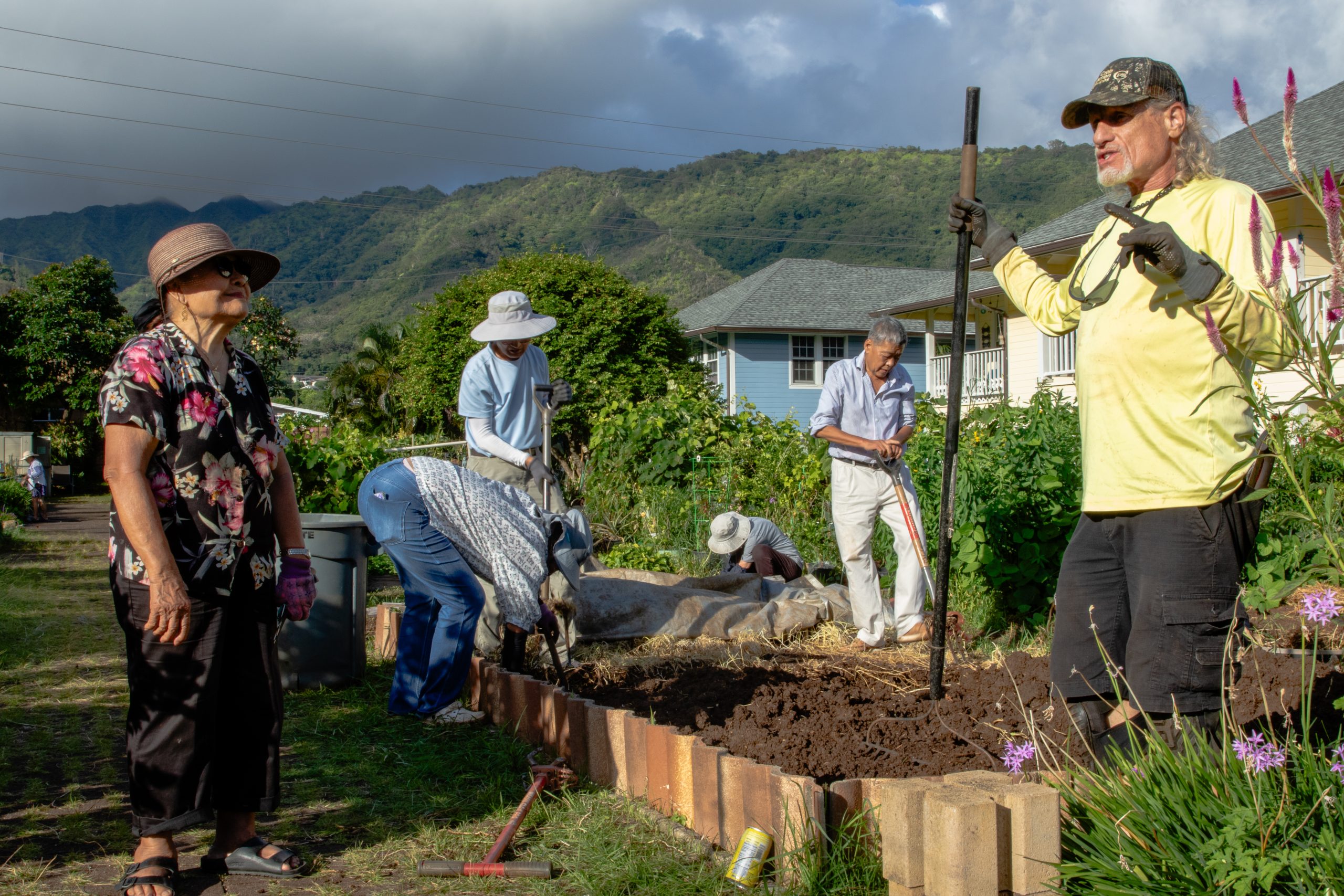
In Mānoa, the appeal is clear. The garden welcomed six new members this year from a 167-person waitlist, said board vice president Craig Ball. Twice-weekly work days bring members together to steward common areas and tackle “deep-rooted issues,” he said, like stubborn grass pushing through brick paths. On a recent Tuesday, several gardeners prepared a fallow plot for a newcomer.
“It’s been marvelous,” Ball said.
Making Space in the Honolulu community garden waitlist
Honolulu’s Department of Parks and Recreation announced in November that it will establish a new community garden at Asing Community Park in ʻEwa Beach. This month, the county set aside $500,000 for the project.
The site would be Leeward Oʻahu’s first county community garden. Plans call for up to 60 plots of 100 square feet each, totaling about 10,000 square feet within the park.
The county reports growing demand for gardening opportunities, including nearly 150 plots located across seven affordable housing projects. Officials have also relaxed long-standing rules to allow certain edible trees in public plantings, including recent efforts along Skyline rail stations. Community garden rules and regulations were updated last year as well.
Despite the Honolulu community garden waitlist pressures, the county has not added a new garden since the 1990s, which is why the ʻEwa Beach project feels like new ground, said Community Gardens Project Manager Anna Mines.
Historically, garden sites were built in response to neighborhood requests, which left some areas outside urban Honolulu underserved. This time, the county used geospatial analysis to identify promising locations, then spent months engaging nearby residents.
“Asing consistently was the best because it does have all these park attributes. It’s large enough, it has bathrooms, it has parking,” Mines said. “What’s even better is the parks staff out there are really enthusiastic about it.”
The county reports growing demand for gardening opportunities, including nearly 150 plots located across seven affordable housing projects. Officials have also relaxed long-standing rules to allow certain edible trees in public plantings, including recent efforts along Skyline rail stations. Community garden rules and regulations were updated last year as well.
Despite the Honolulu community garden waitlist pressures, the county has not added a new garden since the 1990s, which is why the ʻEwa Beach project feels like new ground, said Community Gardens Project Manager Anna Mines.
Historically, garden sites were built in response to neighborhood requests, which left some areas outside urban Honolulu underserved. This time, the county used geospatial analysis to identify promising locations, then spent months engaging nearby residents.
Despite the Honolulu community garden waitlist pressures, the county has not added a new garden since the 1990s, which is why the ʻEwa Beach project feels like new ground, said Community Gardens Project Manager Anna Mines.
The county says it is close to opening a new garden at Asing Community Park in ʻEwa Beach, which would be the first county community garden on the Westside. For most other sites, turnover is rare and plots are scarce.
Honolulu’s Department of Parks and Recreation announced in November that it will establish a new community garden at Asing Community Park in ʻEwa Beach. This month, the county set aside $500,000 for the project.
The site would be Leeward Oʻahu’s first county community garden. Plans call for up to 60 plots of 100 square feet each, totaling about 10,000 square feet within the park.
According to a 2025 county survey that reached about 30% of participating gardeners, a majority maintain plots as a hobby, though many also grow food for their own tables. Of 398 respondents, more than 40% were 65 or older, and women outnumbered men slightly. County studies in recent years conclude that while community gardens are not a comprehensive answer to food insecurity, they support public wellbeing.
In Mānoa, the appeal is clear. The garden welcomed six new members this year from a 167-person waitlist, said board vice president Craig Ball. Twice-weekly work days bring members together to steward common areas and tackle “deep-rooted issues,” he said, like stubborn grass pushing through brick paths. On a recent Tuesday, several gardeners prepared a fallow plot for a newcomer.
The county reports growing demand for gardening opportunities, including nearly 150 plots located across seven affordable housing projects. Officials have also relaxed long-standing rules to allow certain edible trees in public plantings, including recent efforts along Skyline rail stations. Community garden rules and regulations were updated last year as well.
Historically, garden sites were built in response to neighborhood requests, which left some areas outside urban Honolulu underserved. This time, the county used geospatial analysis to identify promising locations, then spent months engaging nearby residents.
The county says it is close to opening a new garden at Asing Community Park in ʻEwa Beach, which would be the first county community garden on the Westside. For most other sites, turnover is rare and plots are scarce.
Honolulu’s Recreational Community Gardening Program has operated for more than 50 years, starting at Makiki District Park and expanding to 10 gardens, most in urban Honolulu. Gardeners cultivate everything from bittermelon and tomatoes to flowers and curry leaves, often decorating plots with personal touches and securing them with locks.
Despite the Honolulu community garden waitlist pressures, the county has not added a new garden since the 1990s, which is why the ʻEwa Beach project feels like new ground, said Community Gardens Project Manager Anna Mines.
Historically, garden sites were built in response to neighborhood requests, which left some areas outside urban Honolulu underserved. This time, the county used geospatial analysis to identify promising locations, then spent months engaging nearby residents.
The county reports growing demand for gardening opportunities, including nearly 150 plots located across seven affordable housing projects. Officials have also relaxed long-standing rules to allow certain edible trees in public plantings, including recent efforts along Skyline rail stations. Community garden rules and regulations were updated last year as well.
In Mānoa, the appeal is clear. The garden welcomed six new members this year from a 167-person waitlist, said board vice president Craig Ball. Twice-weekly work days bring members together to steward common areas and tackle “deep-rooted issues,” he said, like stubborn grass pushing through brick paths. On a recent Tuesday, several gardeners prepared a fallow plot for a newcomer.
According to a 2025 county survey that reached about 30% of participating gardeners, a majority maintain plots as a hobby, though many also grow food for their own tables. Of 398 respondents, more than 40% were 65 or older, and women outnumbered men slightly. County studies in recent years conclude that while community gardens are not a comprehensive answer to food insecurity, they support public wellbeing.
The county reports growing demand for gardening opportunities, including nearly 150 plots located across seven affordable housing projects. Officials have also relaxed long-standing rules to allow certain edible trees in public plantings, including recent efforts along Skyline rail stations. Community garden rules and regulations were updated last year as well.
Historically, garden sites were built in response to neighborhood requests, which left some areas outside urban Honolulu underserved. This time, the county used geospatial analysis to identify promising locations, then spent months engaging nearby residents.
Despite the Honolulu community garden waitlist pressures, the county has not added a new garden since the 1990s, which is why the ʻEwa Beach project feels like new ground, said Community Gardens Project Manager Anna Mines.
Historically, garden sites were built in response to neighborhood requests, which left some areas outside urban Honolulu underserved. This time, the county used geospatial analysis to identify promising locations, then spent months engaging nearby residents.
Despite the Honolulu community garden waitlist pressures, the county has not added a new garden since the 1990s, which is why the ʻEwa Beach project feels like new ground, said Community Gardens Project Manager Anna Mines.
Historically, garden sites were built in response to neighborhood requests, which left some areas outside urban Honolulu underserved. This time, the county used geospatial analysis to identify promising locations, then spent months engaging nearby residents.