
Witnesses appeared before a Hawaii political bribery grand jury in Honolulu on Friday as the state Attorney General’s Office moves toward a conclusion in its probe of a $35,000 payment to a state lawmaker in 2022.
Attorney General Anne Lopez opened the investigation in January following mounting calls to hold both the recipient and the alleged payer accountable. Court filings publicly described the lawmaker only as “influential,” and the person accused of delivering the money has not been named. Potential indictments could come as early as today, though complex matters often take several days of grand jury review. The charges and defendants remain unknown.
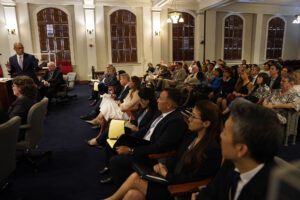
Proceedings at Kaʻahumanu Hale were quiet. Witnesses were escorted into the First Circuit Court’s grand jury room without speaking to reporters, some lining up at a back entrance before doors opened.
Former lawmaker Ty Cullen arrived with attorney Birney Bervar before court opened. Other witnesses included former Hawaiʻi Campaign Spending Commission staffer Tony Baldomero, and Kristen Pae, who entered with defense attorney Tommy Otake. Pae contributed $5,000 to Lt. Gov. Sylvia Luke at a 2022 dinner that is central to the investigation.
An employee of the Department of Health appeared with attorney Eric Seitz. Sources identified the witness as Cathy Ross, a former deputy health director whose division oversaw an office handling procurement and contracts. Salary records show Ross remained a state employee as of February, serving as a human resource specialist.
The Department of Health awarded millions in Covid testing contracts to the National Kidney Foundation of Hawaiʻi. The City and County of Honolulu likewise steered millions to the foundation for mobile testing labs. Businessman Tobi Solidum arranged those contracts, and he is suspected of providing the $35,000.
Former FBI agent and current state investigator Darrin Sakanoi was among those guiding witnesses into the jury room. Sakanoi previously assisted in the federal case against former Honolulu prosecutor Keith Kaneshiro, who was acquitted of corruption charges in 2024.
The $35,000 payment surfaced after a court document tied to the federal bribery case against ex-lawmakers J. Kalani English and Cullen became public. After his 2021 arrest, Cullen cooperated with the FBI and made secret recordings. On Jan. 20, 2022, he captured a meeting with another man and the “influential” lawmaker, during which the man handed over $35,000 for “an existing campaign,” according to that filing. U.S. Attorney Ken Sorenson later said the money was delivered in a paper bag.
Lt. Gov. Sylvia Luke was drawn into the matter in February when she disclosed attending a January 2022 dinner with Cullen, Solidum and Solidum’s stepdaughter, Pae. Luke said she accepted two $5,000 checks from Solidum and Pae and denied ever receiving $35,000, a sum that would exceed legal limits for an individual contribution or gift.
Luke’s campaign did not report the two $5,000 donations until years later when questioned. She said she returned the contributions after Cullen’s arrest, though one refund check was never cashed. She said she then sent $5,000 to the Hawaiʻi Campaign Spending Commission in lieu of that refund.
Luke, who is on unpaid leave and has ended her reelection bid, received a target letter in April. Solidum also received a target letter. His consulting firm took in millions in federal Covid funds in 2020 after helping set up a mobile testing lab through the National Kidney Foundation of Hawaiʻi.
Leo Asuncion Jr., the former chair of the Hawaiʻi Public Utilities Commission who worked on Luke’s 2021–2022 campaign, also received a target letter from the Attorney General’s Office.
Other officials questioned during the probe include former Department of Human Services Director Ryan Yamane. As a state representative in 2020, Yamane sponsored a bill that appropriated $170 million to the Health Department for Covid testing and mitigation. More than half of that funding ultimately flowed through the Kidney Foundation for Covid-related work in the following two years.
Legal experts cautioned that outcomes are uncertain. Former federal public defender Ali Silvert noted that grand juries, especially in complex cases, often meet over multiple days and hear from many witnesses before considering charges. He said such proceedings can take weeks, similar to the Kaneshiro case.
You don’t present a complex case in one morning.
Former prosecutor Randall Lee said obtaining an indictment could prove difficult. He previously led numerous cases involving contractors who illegally funneled money to campaigns in the early 2000s. Prosecutors will need to show that an official changed conduct because of the money, he said.
They got to connect the dots, you need someone on the inside. It’s a tough one. It’s not a slam dunk case.
What the Hawaii political bribery grand jury could decide next
Grand jurors could return indictments quickly, but multiple sessions are common in complex public corruption cases. Any charging decisions will clarify who is implicated in the $35,000 transaction and could close a chapter that has clouded Hawaiʻi politics since 2022.
Some observers say the probe could influence voter trust in future elections and campaigns. Others note that renewed scrutiny of campaign finance rules may dovetail with broader debates over ethics and oversight, similar to concerns raised when a noncitizen voting error in New Jersey led to 400 ballots being cast.