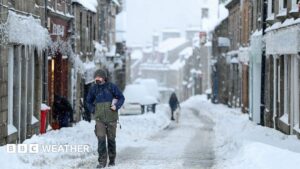

The earliest weakening of the polar vortex could be unfolding, and if the stratospheric winds keep slowing then reverse as forecast, scientists say it would qualify as a major sudden stratospheric warming event. Such events can raise the risk of cold snaps and snow in the United Kingdom, although outcomes vary.
According to Jeff Knight, a lead climate scientist at the UK Met Office, this appears to be the earliest occurrence in the 75 years of observations, with most experts calling it highly unusual. The previous earliest major sudden stratospheric warming was recorded on 28 November in both 1969 and 2025.
The reasons for such an early event are not yet clear. It may simply reflect natural variability in atmospheric patterns. In a typical El Niño year, however, a weakening of the polar vortex is more often seen toward the end of winter, not the beginning.
El Niño’s warmer Pacific waters primarily reshape weather in the tropics, but atmospheric energy pulses known as planetary waves can ripple poleward and disrupt the stratospheric circulation. These waves can displace the polar vortex from its usual position and fragment its flow.
With the current record El Niño disrupting global patterns in unprecedented ways, Knight said it may have helped load the dice for this sudden stratospheric warming. He emphasized that the event is rare and the evidence is not sufficient to confirm a direct link.
Scientists say any connection between a strong El Niño and an early sudden stratospheric warming remains uncertain and will require further study.
Earliest weakening of the polar vortex and Hawaii context
For Hawaiʻi, El Niño often brings warmer ocean waters and shifts in rainfall. While the state is far from polar impacts, changes to the jet stream tied to sudden stratospheric warming can ripple across mid-latitudes and influence broader Northern Hemisphere weather patterns that affect air travel, supply chains, and tourism between the islands and the mainland or Europe.
Researchers note that these changes may compound other climate-related pressures on infrastructure and economies, echoing broader concerns that most voters link climate change and the American Dream in complex ways.
Officials at the UK Met Office and other national meteorological agencies are monitoring the polar vortex and associated jet stream shifts closely this season.
They are coordinating with partners such as the U.S. National Oceanic and Atmospheric Administration to track how evolving El Niño conditions and any sudden stratospheric warming may affect transoceanic flight routes and weather-sensitive sectors.