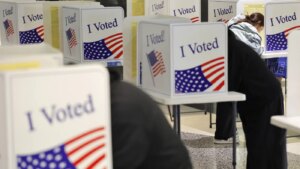

Tuesday’s elections brought sweeping wins for Democrats and put midterm ballot measures in the spotlight, as voters across the country weighed policy changes on abortion, voting, LGBTQ rights, taxes, guns and fast-growing AI data centers.
In all, voters in 39 states, along with Washington, D.C., and the Northern Mariana Islands, decided 146 statewide questions on issues ranging from taxes and transgender participation in sports to traffic cameras, data centers and artificial intelligence.
Here is a look at key outcomes.
Abortion, voting and other key midterm ballot measures
Three states moved to preserve abortion access
After the U.S. Supreme Court ended Roe v. Wade in 2022, many states turned to the ballot to set abortion policy, and most have chosen to protect access.
This year, four states considered abortion-related measures. Three were approved, while Idaho voters opted to keep the state’s 2022 abortion ban in place.
Missouri voters rejected a GOP-backed proposal that would have imposed a near-total abortion ban with limited exceptions. The vote affirms support for abortion access two years after voters moved to undo one of the nation’s strictest bans.
Nevada voters backed adding abortion protections up to the point of fetal viability to the state constitution. It is the second consecutive election they have done so, as Nevada requires constitutional amendments to pass twice.
In Virginia, voters endorsed a constitutional amendment establishing a fundamental right to reproductive freedom. It protects abortion in the first two trimesters, and in certain cases afterward, and also safeguards contraception, fertility treatment, postpartum care and related services.
States voted on voting
Several states considered how elections are run. As of Wednesday afternoon, some sweeping proposals remained undecided in Alaska and Arizona.
Voters in Nevada, North Carolina and Ohio approved tougher voter identification rules, while California voters rejected a similar requirement.
Alaska, Arkansas, Kansas, South Dakota and West Virginia approved measures clarifying that only U.S. citizens may vote.
Redistricting also drew attention after calls earlier this year to redraw boundaries ahead of the midterms. Some Republican-favored maps ultimately delivered wins to Democrats.
Missouri voters turned down a congressional map viewed as favorable to Republicans. Maryland voters approved a redistricting amendment that could open the door to a Democratic-leaning map in 2028.
Virginia voters passed a measure to automatically restore voting rights to people with felony convictions once they complete their sentences.
A mixed bag for LGBTQ rights
Virginia voters approved removing an outdated same-sex marriage ban from the state constitution and added language recognizing marriage between two adults regardless of sex, gender or race. The change is seen as a safeguard should the Supreme Court’s 2015 marriage equality ruling ever be reversed. Similar steps were taken by states including Colorado and California in 2024.
Vermont voters overwhelmingly adopted a constitutional amendment guaranteeing equal protection under the law regardless of race, ethnicity, sex, religion, disability, sexual orientation, gender identity, gender expression or national origin.
Several states weighed restrictions involving transgender youth. Colorado approved measures limiting transgender students’ participation in school sports and restricting gender-affirming care. A Washington state proposal to bar trans girls from girls’ school sports was leading on Wednesday.
Arizona approved a proposal requiring schools and athletic groups to restrict use of facilities such as restrooms and locker rooms to a person’s sex assigned at birth. The measure would also extend sports restrictions to some recreational leagues.
Taxes and state spending up for debate
Florida voters overwhelmingly approved a constitutional amendment to cut property taxes for homeowners. Opponents warned the change could strip billions from local services such as food banks, libraries, transit and infrastructure.
In California, voters considered a one-time 5% tax on individuals with assets over $1 billion, largely to fund health care services. The high-spending contest remained too close to call Wednesday afternoon.
Tennessee voters approved a constitutional ban on a statewide property tax, which the state has not levied since 1949. Arizona voters backed a measure preventing cities and towns from raising taxes on groceries until July 2027. North Carolina approved capping the maximum personal income tax rate at 3.5%.
Washington voters weighed repealing an income tax on individuals and households earning more than $1 million that is scheduled to start in 2028. Early results suggested voters want to keep the tax.
A polar-opposite pair of gun ballot measures
Massachusetts voters chose to keep a 2024 law that tightened gun regulations, including serial numbers for ghost guns, an expanded definition of assault-style firearms and broader red flag provisions, placing the state among the strictest on gun control.
In Idaho, voters were asked to select a state gun from six models. The Winchester Model 1873, known as the “Gun that Won the West,” led as of Wednesday. Lawmakers would still need to act to make any selection official.
The ballot initiatives about data centers
Data centers, central to AI development and power demand, faced widespread local resistance. Jurisdictions in California, Florida, Illinois, Kansas, Maine, Nevada, New Jersey, North Dakota, Ohio and Wisconsin voted to restrict them.
At least 12 localities moved to limit the size of data centers and six backed halting or banning construction, according to Data Centers on the Ballot. One community, Harwood, North Dakota, voted by 75% not to place new limits on industrial projects, including data centers.
Ohio featured 21 local measures referencing data centers. Voters in Trenton approved a ban on facilities over 25 megawatts, while Hubbard moved to prohibit construction of data centers of any size, including conversions of existing buildings. Voters also rejected rezoning rural residential land for light industrial use tied to data centers.
Campaigns spent up to $40 million on data center-related ads this cycle. A June Reuters/Ipsos poll found 77% of Americans worry data centers will raise electricity costs. The survey also found two-thirds of Democrats and about half of Republicans would oppose a data center in their community.
Other honorable mentions
Alabama voters approved requirements for local school boards to adopt policies directing public K-12 schools to recite the Pledge of Allegiance and, separately, to play or perform the first stanza of The Star-Spangled Banner at least once a week during school hours.
Arizona voters passed a measure prohibiting the state from using photo enforcement systems such as speed and red-light cameras to cite certain traffic violations.
In Washington, D.C., voters overwhelmingly approved a ban on the force-feeding of birds to enlarge their livers and on the sale of foie gras. Voters in Denver adopted a similar measure.
Some Republican-favored maps ultimately delivered wins to Democrats in a pattern reminiscent of how midterm races often hinge on structural advantages and turnout.
For more information on voting rules and election administration, readers can visit the U.S. Election Assistance Commission.
Details on abortion-related measures and outcomes are available from the Ballotpedia database of ballot measures.