
State ballot measures drew intense attention as voters backed abortion protections in several states and rejected efforts aligned with former President Donald Trump’s redistricting push. The decisions arrived alongside a high-profile midterm in which Democrats captured Congress and made gains in governorships and state legislatures.
Some questions put Trump-era priorities to voters, including proposals on redrawing congressional maps, restricting transgender participation in sports and tightening voter identification rules.
Abortion rights advance in multiple state ballot measures
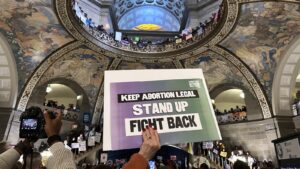
Missouri voters turned down a proposed constitutional amendment that would have restored significant limits on most abortions. The outcome effectively reaffirmed a decision from two years earlier, when voters approved an abortion-rights amendment that overturned a prior ban.
Lawmakers had placed a revised, narrower ban on this year’s ballot that would have allowed abortions only in medical emergencies and cases of fetal anomalies, and permitted abortions in cases of rape or incest up to 12 weeks. It also sought to restrict certain medical procedures for transgender minors. Abortion-rights groups, backed by national progressive organizations, outspent opponents in the successful campaign to defeat it.
Virginia voters approved a constitutional amendment establishing a “fundamental right to reproductive freedom,” ensuring abortion access during the first two trimesters and protecting contraception and fertility care. In Nevada, voters gave final approval to add a fundamental right to abortion until fetal viability, generally considered after 21 weeks, following an initial yes vote in 2024.
Since the U.S. Supreme Court ended the nationwide right to abortion in 2022, more than one-fifth of states have adopted ballot measures safeguarding abortion access. Still, Republican-leaning Idaho rejected a proposal to create abortion rights in state law.
Idaho currently bans abortions unless necessary to save the life of a pregnant woman, or during the first trimester in reported cases of rape or incest. Abortion-rights measures also failed two years ago in Florida and South Dakota.
Voters rebuke Trump-backed redistricting efforts
Nine states used new congressional maps after mid-decade redistricting encouraged by Trump. In Missouri, Republican lawmakers adopted a map intended to help the GOP pick up a Kansas City-area seat.
After opponents forced a referendum, courts ruled the map could not be reused without voter approval. Voters ended it by rejecting the redistricting law.
In Maryland, voters endorsed a constitutional amendment that could enable new congressional districts in 2028. Democratic supporters, with backing from former President Barack Obama, urged a yes vote to “stop Trump.”
In Colorado, a citizen initiative on the ballot would prohibit any 2028 redistricting from favoring a party and require approval from both an independent commission and the state Supreme Court.
Property taxes, transgender rules and school sports
Florida voters passed a measure that will significantly expand property tax exemptions for primary residences. The existing $50,000 exemption will triple next year for non-school taxes and rise to $250,000 in 2028.
The proposal, advanced during a special session called by Republican Gov. Ron DeSantis, could reduce local revenues, with some officials warning of potential cuts to police and fire services, libraries and parks.
Nebraska voters approved adding existing restrictions on transgender medical care to the state constitution. In Arizona, voters passed a measure extending public school sports restrictions to private schools.
Colorado and Washington voters were also weighing measures on transgender athletes, and Colorado faced a second question to ban some medical treatments for minors. The votes came as the Trump administration advocated for broader national restrictions affecting transgender youth.
Voter ID questions split the electorate
While nationwide voter ID legislation has stalled in Congress, activists placed new requirements on ballots in several states. California voters defeated a proposal to require a government-issued ID for in-person voting or the last four digits of that ID to vote by mail.
Colorado voters also rejected a plan to require mail voters to provide the last four digits of a government ID number.
In contrast, Ohio and North Carolina voters approved measures to enshrine or enhance existing voter ID rules in their constitutions. Nevada voters also passed a voter ID amendment.
Citizen initiative thresholds and limits on noncitizen voting
North Dakota and South Dakota voters rejected proposals to raise the approval bar for constitutional changes from a simple majority to 60 percent. Utah voters similarly turned down a 60 percent threshold for citizen initiatives that would raise taxes.
Missouri voters approved an amendment making it harder for lawmakers to alter voter-approved initiatives, requiring any legislative revisions to pass with 80 percent support in both chambers.
Voters in Arkansas, Kansas, South Dakota and West Virginia approved constitutional amendments affirming that only U.S. citizens can vote. Alaska voters approved a similar policy as state law.
Critics say such measures are largely symbolic because noncitizen voting is rare, already illegal in federal elections, and allowed only in limited local contests in some jurisdictions.
Traffic cameras curbed in Arizona
Arizonans approved a measure limiting the use of traffic cameras to ticket drivers for speeding or red light violations. The Republican-led Legislature referred the issue to the ballot after Democratic Gov. Katie Hobbs vetoed a ban, arguing cameras improve safety.
Opponents cite privacy concerns and instances of misuse. The measure blocks new traffic camera contracts starting in 2027 and requires local votes to keep existing systems.
About half of states, including Arizona, have communities using automated enforcement, according to the Insurance Institute for Highway Safety.
Geoff Mulvihill contributed to this report.