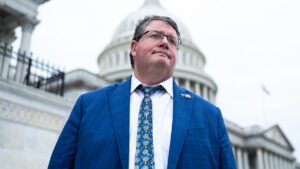

The Kansas Senate debate featured Sen. Roger Marshall and Democratic challenger Adam Hamilton in a tense exchange over Donald Trump, immigration, Iran, transgender athletes, artificial intelligence, and personal controversies less than two weeks before Election Day. The hourlong Kansas Senate debate comes as Marshall seeks a second term and Hamilton, a longtime pastor, attempts to become the first Democrat elected to the U.S. Senate from Kansas since 1932. The contest has drawn national attention as both parties vie for control of the chamber, and Trump traveled to Kansas earlier in the week to rally supporters for Marshall.
Here are five moments that stood out during Wednesday night’s debate.
Debate opens with candidates confronted over personal controversies
Moderators began by pressing both candidates on issues that have fueled attacks on the trail. Marshall was asked about a New York Times review that found his former medical practice sued more than 700 patients over unpaid bills. He said his practice provided millions in charity care annually but also had to meet payroll and other obligations.
Hamilton faced questions about his response to allegations involving a volunteer at his church’s summer camp who was accused of sexual abuse. He said he should have ensured the individual did not return after an initial investigation, calling it a mistake.
Marshall says ‘President Trump is not always right’
Trump’s presence in the race was front and center after moderators played remarks from his Kansas rally urging voters to act as if he were on the ballot. Asked if that meant he would back every part of Trump’s agenda, Marshall said no, noting there were multiple times he objected to the former president.
Pressed for specifics, he cited recent immigration enforcement actions in southwest Kansas and Trump’s stance on beef imports. Marshall appealed to Trump voters to turn out for him, arguing a Hamilton win could help Democrats secure the Senate.
Both candidates say there are ‘two genders’
In a rare point of agreement, both contenders said there are two genders. Marshall referenced his years as an obstetrician, while Hamilton stated there are male and female.
The discussion moved to transgender participation in women’s sports. Hamilton said eligibility decisions should generally be handled locally but opposed biological males competing against females, saying it is not fair or safe.
Marshall said that by high school, boys should compete in boys sports and girls in girls sports, accusing national Democrats of promoting transgender ideology. Hamilton later accused Marshall of using the issue to pick on and bully people.
Hamilton calls AI an ‘existential threat’ but offers no specific rules
Hamilton urged stronger federal oversight of artificial intelligence, likening it to the advent of nuclear power and advocating for a regulatory commission. When asked to name specific rules he would back, he said he was not sure yet, arguing even experts are still grappling with the risks.
Marshall endorsed a light-touch approach focused on national security, transparency, protecting children, and privacy. Hamilton pushed back, calling AI a potential existential threat that cannot rely on minimal regulation.
Hamilton calls Biden’s border policies a ‘disaster’
Seeking to underscore his pledge to “lead from the middle,” Hamilton distanced himself from President Joe Biden when asked to identify a progressive policy he opposed. He called Biden’s border policies a disaster and said he supports strong and secure borders.
Hamilton added he does not align with the Socialist Party and reiterated during the debate that he would not back Senate Minority Leader Chuck Schumer for majority leader if Democrats claim control of the Senate.
Kansas Senate debate draws national focus as control of chamber hangs in balance
With the nation’s attention on a potential shift in Senate control, both campaigns are appealing to base voters and moderates alike. Trump’s visit highlighted the Republican effort to lock down a traditionally red state, while Hamilton’s critiques of Biden and Schumer signaled an attempt to court centrists.
For Hawaiʻi readers watching mainland races that could affect federal policy on immigration, technology, and civil rights, the Kansas outcome could help shape the next Senate’s agenda. The eventual winner will serve alongside the rest of the Senate in considering major bipartisan legislation and confirming key nominees to lead agencies such as the Department of Homeland Security and the Department of Justice.