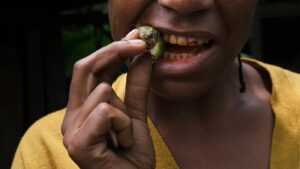

Ancient betel nut use may explain unusual grooves found in human teeth from archaeological sites in Indonesia, according to researchers who say the findings point to an early phase of the practice in which people sucked, rather than chewed, the seeds for their effects.
About 600 million people today consume betel nuts, the walnut-sized seeds of certain palms. Users report freshened breath, relief from indigestion and a stimulant lift, while health experts warn that long-term use can harm teeth, raise cardiovascular risks and contribute to oral cancers.
Ancient betel nut use and archaeological clues
A study published in Science Advances argues that the attraction to betel nuts stretches far into the past. By examining ancient teeth, researchers propose that hunter-gatherers developed a habit of sucking on whole nuts, potentially to numb pain.
“It’s a chance archaeological discovery that reveals an initial stage in the development of this common drug used today,” said Adam Brumm, an archaeology professor at Griffith University in Australia who led the work. “We think it might have started with hunter-gatherers just sucking on the nuts, almost like gobstoppers.”
Puzzled by “strange grooves”
The investigation began with two sets of human remains recovered on Sulawesi, an island in present-day Indonesia. One individual dates as far back as 25,000 years, and a second, found about 20 miles away, lived up to 8,000 years ago. Both sets displayed unusual, deep grooves on multiple teeth.
Brumm said the wear was unlike patterns linked to known behaviors such as using teeth as tools or processing plant fibers by mouth. The grooves were severe enough in some teeth to expose the pulp cavity, suggesting decades of repetitive contact with hard, round objects.
Seeking a cultural explanation, the team drew parallels to distinctive notches seen in the teeth of historical pipe smokers who clenched clay stems between their teeth over many years.
The case for the betel nut
While modern betel nut consumption in Asia and the Pacific often involves chewing mixtures that combine the seed with lime and other additives, the wear patterns on the ancient teeth point to prolonged sucking. To test whether that action alone could produce a pharmacological effect, Brumm collaborated with Roger Papke, a neuropharmacology researcher at the University of Florida.
The team soaked whole betel nuts in artificial saliva, then applied the resulting extract to frog egg cells engineered with human brain receptors. The extract activated the receptors, indicating that arecoline, the nut’s active compound, can be drawn out through saliva and potentially absorbed into the bloodstream during sucking.
To tie the behavior to the ancient individuals, the researchers matched the size and hardness of betel nuts to the observed grooves and analyzed dental tissue. They detected traces of arecoline, a chemical for which betel nuts are the only known natural source.
Brumm also tried the practice himself, reporting a bitter, astringent taste and a numbing sensation. He hypothesizes that ancient users may have sought pain relief and, over time, wore teeth down to the nerve, which could have intensified the cycle of use.
Human nature
Outside experts say the evidence is persuasive, though not definitive. Peter Ungar, a University of Arkansas anthropologist who studies teeth, called the wear and chemical findings a strong indicator of betel involvement. Princeton anthropologist Agustín Fuentes said the results align with broader understandings of betel use and cultural dynamics of the era.
Other researchers urged caution, noting the study is based on two individuals and that tropical environments rarely preserve remains well. They said direct finds of nuts or seeds in domestic or ritual contexts would further strengthen the case.
Scholars also warned against assuming pain relief was the sole motivation. Social or cultural practices can drive behaviors that are hard on teeth, similar to how people today may eat hard candy or use teeth in ways that are not dental-health friendly.
Brumm acknowledged the limits of the available evidence. He said the team’s multidisciplinary approach, combining wear analysis, laboratory tests and chemical signatures, supports the interpretation that ancient betel nut use began with a simple habit of nut-sucking that later evolved into the widespread practice seen across Asia and the Pacific.
Health experts who track stimulant use and oral health trends, including those discussed in ongoing debates over public health oversight such as in a recent CDC reliability hearing, say long-term monitoring of betel consumption remains important in the modern era.